Posts

Sopore Kashmir

Sopore,{sə(ʊ)ˈpɔ:} (Hindi:सोपोर) known asSuyyapurin antiquity,[2]is a town in theBaramulla districtof theIndianstateofJammu and Kashmir. It is 35 km (22 mi) north-west ofSrinagar, and 16 km (10 mi) south-west from the city ofBaramulla.HistorySopore was founded by Utpalaengineerand irrigation minister Suyya during the peaceful reign of king Avantivarman in 880 CE.[3]As such the name of the city is Suyya-pur, which has been shortened to Sopore.[3]When the engineer Suyya was working in Sopore no people were coming forth to plunge themselves in gushing water.[3]The king, Avantiverman, thereupon ordered that a part of treasury may be thrown into the water; consequently, a large number of people plunged into the river to get asmany coins as they could.[3]The skill of Suyya worked and the river was cleared of silt.[3]Some Pashtun tribesmen such asMehsudandAfridifrom mountainous region ofNorth-West Frontier Province(NWFP) of the newly formed state of Pakistan invaded the Kashmir valley on 22 ...

Bandipora

Bandipora(ˌbændɪˈpɔː) (misspelled asBandipore,Bandipur,Bandipura) (Kashmiri:بنڈ پُور,Urdu:بانڈی پور‎( is the administrative headquarters of the district ofBandiporain thestate ofJammu and Kashmir, India. It is located on the northern banks ofWular Lake- the biggest fresh water lake in Asia. Bandipora has aterrace gardensimilar to theNishat Baghin Srinagar. In Kashmiri there is a famous phrase about Bandipora or in other words Bandipora is famous for three A's - A'lim (knowledge), Adab (good habits or literature) and Aab (water). As can be known from the folklore, the name of Bandipora (pronounced asBand e pur) originated either from Band of Wullar Lake, due to the Bands of place or due the Closed (Band in Kashmiri) geographical location (i.e., Bandipora is bound by mountains on three sides and by Wullar Lake in the fourth).GeographyBandipora is situated on the banks of theWular, the largest fresh-water lake in Asia which is home to a lot of migratory birds. Inadvertent dumping...

Kashmiri language literature

The use of theKashmiri languagebegan with the workMahanayakaprakash(Light of the supreme lord) byShitikantha(c.1250),[1]and was followed by the poetLalleshvarior Lal Ded (14th century), who wrote mystical verses in thevakhor four-line couplet style.[2]Another mystic of her time equally revered in Kashmir and popularly known asNunda Reshiwrote powerful poetry like his senior Lal Ded. Later cameHabba Khatun(16th century) with her own style. Other major names areRupa Bhavani(1621–1721),Arnimal(d. 1800),Mahmud Gami(1765–1855),Rasul Mir(d. 1870),Paramananda(1791–1864),Maqbool Shah Kralawari(1820–1876). Also, theSufipoets like Shamas Fakir, Wahab Khar, Soch Kral, Samad Mir, and Ahad Zargar. Among modern poets areGhulam Ahmad Mahjur(1885–1952),Abdul Ahad Azad(1903–1948), andZinda Kaul(1884–1965).During the 1950s, a number of welleducated youth turned to Kashmiri writing, both poetry and prose, and enriched modern Kashmiri writing by leaps and bounds. Among these writers areDinanath Nadim(191...

Kashmiri literature

Kashmiriliterature(Kashmiri:कॉशुर साहित्य,کٲشُر ساہتیہ) has a history of at least 5,000 years, going back to its glorydays ofSanskrit. Early names includePatanjali, the author of theMahabhashyacommentary onPāṇini'sgrammar, suggested by some to have been the same to write theHindutreatise known as theYogasutra, andDridhbala, who revised theCharaka SamhitaofAyurveda.In medieval times the great Kashmir Valley School of Art, Culture and Philosophy KashmirShaivismarose. Its great masters includeVasugupta(c. 800), Utpala (c. 925),Abhinavagupta, andKshemaraja. In the theory of aesthetics one can list theAnandavardhanaandAbhinavagupta. Many generations later, in our modern times, a new lease of life given, tosame "school of thought" was given bySwami Lakshman Jooof Ishbher/Gupta Ganga, Srinagar, India.

Wular lake Bandipora

Image
Wular Lake(also speltWullar), One of the largestfresh waterlakes in Asia, is inBandipora districtin the In dian state ofJammu and Kashmir. The lake basin was formed as a result oftectonicactivity and is fed by theJhelum River. The lake's size varies seasonally from 12 to 100 square miles (30 to 260 square kilometers). Boating, water sports and water ski have recently been launched by the Government of India Tourism in collaboration with Kerala Tourism and J&K Tourism. The contract for the operation of the site was awardedin September 2011.

Harmukh

Image
By abid wani (KashGraph) Harmukh(also known as Mount Haramukh or Harmukh mountain) is a mountain with a peak elevation[2]of 5,142 metres (16,870 ft), inGanderbal districtofJammu and Kashmir. Harmukh is part of theHimalayaRange, and is located betweenNallah Sindhin the south and KishangangaNeelum Riverin the north, rising aboveGangabal Lake[3]in the vicinity ofKashmir valley. It is mostly climbed from the northwestern side of ArinBandipore.Religious beliefsHarmukh, with Gangbal Lake at its foot, is considered a sacred mountain byHindus.[4]According toHindu mythology, Harmukh is the abode of LordShiva.[5][6]According to the legend of "Hurmukhuk Gosoni"[7]Once a hermit tried to reach the summit of Harmukh to see Lord Shiva face to face. For twelve long years he tried to scale the summit, but failed until one day he saw a Gujar descending the summit. When the Gujar approached him, thehermit enquired as to what he had seen there. The Gujar saidhe had been searching for a stra...

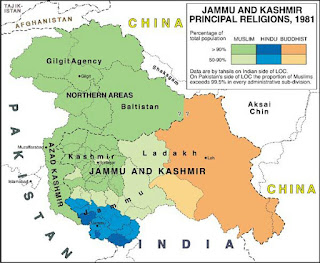
JAMMU AND KASHMIR: DISTRIBUTION OF RELIGIONS

Image
Three major faiths are each clearly dominant in different parts of the erstwhile princely state of Jammu and Kashmir.Islam is virtually the sole religion throughout the Northern Areas and Azad Kashmir on the Pakistani side of the 1972 Line of Control, accounting for more than 99.5% of the population in every single district of those two areas. On the Indian side of the LOC, Islam is clearly dominant in Kashmir, is also the leading faith in three of the six districts of Jammu, and accounts for a large majority of the population in the Kargil tahsil of Kargil district. Hinduism, the second most numerous faith, accounts for a majority ofthe population in the three southernmost districts of Jammuand in that region as a whole. Followers of the Tibetan form of Buddhism are a decided majority in the large, but thinly populated district of Leh and in Zanskar tahsil in the southern part of Kargil district. In Jammu and Kashmir as awhole, Islam is by far the leading faith and, with 74.9% of the...